Trickle Up:
The theory of 'Trickle-Up fashion' is when a style or trend that is started and worn by a lower income group of people. These everyday people make the trend popular and the specific style is copied by catwalk fashion that is more high end.
Trickle Down:
The theory of 'Trickle-Down fashion' is the opposite of trickle up. High end designers produce trends and styles that become very popular and worn a lot. High street stores then use the designs as inspiration for their own designs.
Trickle Across:
The theory of 'Trickle-Across fashion' is when a shop is able to appeal to a large variety of people with different price ranges and styles. It does this while still being produced on a mass basis. It suits a wide range of peoples budgets and style and appeals to lots of customers. The stores normally split into different sections where they have high street at one side and high end at the other so the customers can go over and look through the section that suits them the best.
Tuesday, 12 April 2016

Tuesday, 15 March 2016
Minimum Wage; How it affects Fashion?
 https://www.gov.uk/guidance/rates-and-thresholds-for-employers-2015-to-2016

National Minimum Wage
The National Minimum Wage is the minimum pay per hour almost all workers are entitled to by law.
The rates below are from the 1st October 2015 and are likely to change again on 1 October 2016 as they usually go up every year.
| Category of worker | Hourly rate |
| Aged 21 and above | £6.70 |
| Aged 18 to 20 inclusive | £5.30 |
| Aged under 18 (but above compulsory school leaving age) | £3.87 |
| Apprentices aged under 19 | £3.30 |
| Apprentices aged 19 and over, but in the first year of their apprenticeship | £3.30 |
| Year | 21 and over | 18 to 20 | Under 18 | Apprentice* |
|---|---|---|---|---|
| 2015 (current rate) | £6.70 | £5.30 | £3.87 | £3.30 |
| 2014 | £6.50 | £5.13 | £3.79 | £2.73 |
| 2013 | £6.31 | £5.03 | £3.72 | £2.68 |
| 2012 | £6.19 | £4.98 | £3.68 | £2.65 |
| 2011 | £6.08 | £4.98 | £3.68 | £2.60 |
| 2010 | £5.93 | £4.92 | £3.64 | £2.50 |
UK's low wage workers are to see the national minimum wage, which currently stands at just 6.50 pounds per hour, rise to 7.20 pounds for over 25s and rising to 9 pounds by 2020.
Whilst this is great news for workers struggling on a low income trying to survive in one of the most expensive cities in the world, the fashion and retail industry has warned its sector faces a huge rise in labor costs after the government's promise to raise the national wage.
From April next year, businesses will be required to increase the wage, with some high street retailers, like Next, already issuing profit warnings. Next has stated the National Living Wage will cost the business 27 million pounds each year from 2016 until the end of the decade.
Next will see its wage bill increase to 147 million pounds
Next year's increase will cost the business just 2 million pounds but thereafter the increases will be much higher, taking the total wage bill to 147 million pounds by 2020.
The retail industry is, of course, staffed by many low-wage workers. Boutique assistants and stockroom staff are some of the lowest paid jobs in the country, despite being part of a key sector to the UK economy. The fashion industry employs nearly 3 percent of the population at just under 800,000 workers. Many of whom are on the minimum wage.
I believe that as the minimum wage increases each year, retailers and companies start to loose out on money as they have to pay their workers a higher wage which cuts into there profits. You would think this is the case but i personally think that when the wage goes up, so does the companies price that they charge. For example, if the minimum wage goes up by 20p then a business like Topshop would increase there prices of clothes by 20p, if not more. They would do that so they don't end up loosing a profit. I also believe that they need to do this because if the minimum wage rises so does the cost of their manufacturing and producing the garments as they need to pay those workers more meaning that the average production of a garment goes up. If they kept the price of the clothes the same when the minimum wage rises each year, then they would end up loosing a large amount of their profit. This is because they would be paying their workers from each part of the cycle a higher amount but they wouldn't be getting the money from anywhere but there profits. But if there profits are rising then it doesn't matter if they cut into it a little to pay the workers more.
I believe that increasing the minimum wage each years seems like a great idea but it reality i think that increasing the wage means increasing the price of living. Workers will be paid more but household items, clothes, groceries and leisure would also increase in price meaning that by upping the wage doesn't actually increase your overall income.
Tuesday, 2 February 2016
Calvin Klein
 Calvin Klein is an American
fashion house founded by the fashion designer Calvin Klein. The company is
headquartered in Midtown Manhattan, New York City and is currently owned by PVH.
Calvin Klein is an American
fashion house founded by the fashion designer Calvin Klein. The company is
headquartered in Midtown Manhattan, New York City and is currently owned by PVH.
In 1968, Klein founded Calvin Klein Limited, a coat shop in
the York Hotel in New York City, with $10,000. The first Calvin Klein
collection was a line of "youthful, understated coats and dresses"
featured at the New York City store, Bonwit Teller.
About the designer:
Calvin Klein was born on November 19, 1942, in
Bronx, New York. He studied fashion in New York City and apprenticed for a suit
manufacturer. In 1968, he opened his own company. He was initially recognized
for suits and coats, but his sportswear line became popular as well. He
received three Coty Awards for womenswear. His business now includes clothing, cosmetics, fragrances and home collections.
Promotion:
Celebrity endorsement:
Celebrity branding is a type of branding or advertising in
which a celebrity becomes a brand ambassador and uses his or her status in
society to promote or endorse a product, service or charity.
Calvin Klein is known for its celebrity endorsement, from supermodels to actors and singers. Calvin Klein normally have a massive campaign with there chosen celebrity that consists off many billboard pictures, adverts and short videos to help promote the brand. Using


Product:
Calvin Klein; Women's Underwear Sets.


Price: Sports bra £30
Normal bras range from £32 to £53
Pants range from £18 to £31
In fiscal 2013 (ended January) Calvin Klein Licensing rang up $425 million in sales, while Calvin Klein Apparel brought in $750 million. Overall, worldwide retail sales of products sold under the Calvin Klein brands were approximately $7.6 billion fiscal 2013.
Place:
Online. They have a hugely popular online sites available to view all over the world. You can order from them at any time and get them to deliver to your house at a shipping cost, depending on where you live.
Stores. As of today, there is only one Calvin Klein Collection store operated by CKI. However they do have hundreds of stores worldwide but these are for underwear and a few are sportswear as well.
Couture, Global, Mail Order, Elite Chain, Mass Market, High Street and Street Fashion

High End (Designer)
Elie Saab
Elie Saab was born on the 4th of July 1964. He is a Lebanese fashion designer. His main workshop is in Lebanon, with additional workshops in Milan and Paris.
The brand of Elie Saab is very expensive with dresses ranging from 3,000, 8,000 to even 10,000.


I absolutely love Elie Saabs dresses as they are colourful, feminine and sophisticated. His work is effortless and always on trend. He continues to design garments that are worn all over the world by celebrities and rich well known people.


High Street
H & M Hennes & Mauritz (H&M) is a Swedish multinational retail-clothing company, known for its fast-fashion clothing for men, women, teenagers and children. H & M clothes ranges from £20-£30 for dresses, £7.99-£19.99 for tops and £7.99-£24.99. I really like the clothing in H&M as they are fashionable at affordable prices. The clothes are normally inspired by high-end/designer clothes so they are always on trend with the newest styles.


Tuesday, 26 January 2016
Marketing Mix- 4 P's and Pop-Up Store
4P's of Marketing.
Product- What a business offers so satisfy its customers.
Price- The amount the customer pays for a product
Promotion- The way a customer is informed about a product, how they first see the product.
Place- (Distribution) involves getting the product to the customer.


Product- What a business offers so satisfy its customers.
Price- The amount the customer pays for a product
Promotion- The way a customer is informed about a product, how they first see the product.
Place- (Distribution) involves getting the product to the customer.

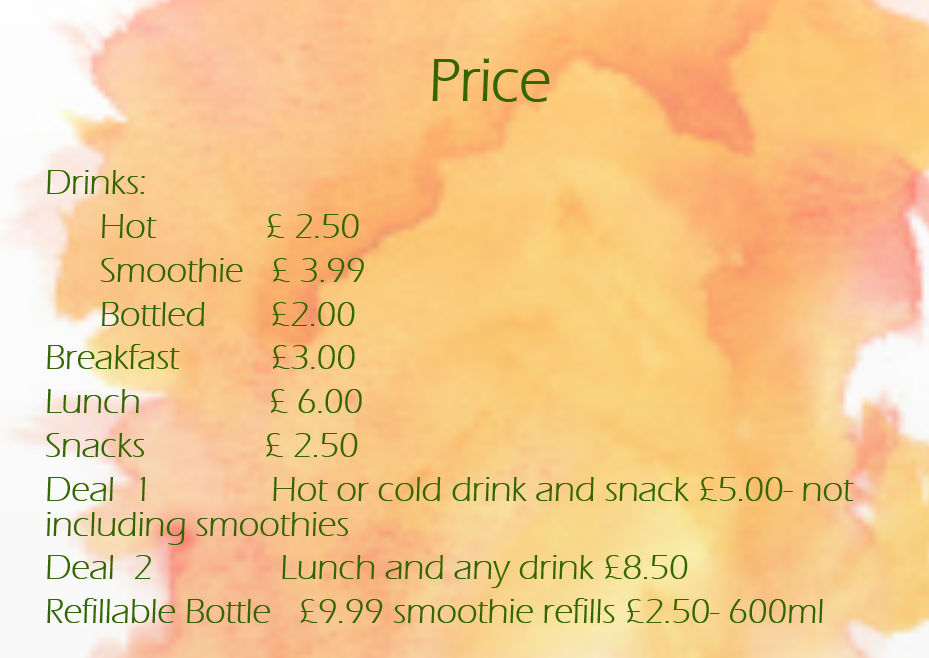
Product: Our pop up store was called 'Health Kick' a healthy eating shop that sells organic foods and drinks for breakfast lunch light dinners and snacks. Deciding on the price was difficult as we wanted it to be cheaper than going to a restaurant but not be too expensive as we have some competitors. We had to think about our products and that the ingredients need to be fresh and organic meaning that they are more expensive to buy than pre-packaged frozen foods. Our packaging wanted to reflect our product which we wanted to be environmentally friendly. We decided on brown paper bags so that it is easily disposed of and is recyclable. We also added disposable cutlery that could also be washed and re-used, using recyclable materials. We would also have the name of the brand on the bags so that it promotes the store as well. The pop up store would be placed around office blocks, gyms, leisure centers, and local stores.




Marketing Mix

A marketing mix is a business tool used in marketing. The marketing mix is very crucial when determining a product/brands price product promotion and place. Working in a group we designed a cake with different layers. We wrote down the different ingredients used to make the cake. The ingredients work as the 4 p's and show that without each ingredient, the cake wouldn't work. So without each of the 4 p's, marketing wouldn't work as well.
Past, Present & Future Advertising

I focused on the brand Heinz to research their past and present advertising techniques. I started this research by searching for the first ever advertising from the brand which was in black and white. Heinz was founded in 1869 so advertising at that time was mostly posters and leaflets as technology wasn't advanced/ wasn't existing. The advertising consisted of images of the product with lots of detailing, a title, and written information about the product. As Heinz's advertising becomes more modern it actually becomes less detailed. Nowadays their advertising is very minimal and with just one image and their famous logo on a poster. I feel that this is because they are a well known brand so don't need lots of detailed information to get their brand identity across to customers. I noticed that the most recent advertising techniques include humour which is a great way to advertise. They will catch the customers eye and is more likely to stick in their mind if it made them laugh.
I think that in the future, Heinz will have more 3D advertising. This is because technology is getting very advanced. Maybe in a couple years, they might even have interactive advertising. I believe that this would be a great way to advertise as it would make the customers remember the brand and would probably tell their friends about it.
What is fashion marketing and Scale Diversity
Fashion marketing is the process of increasing awareness of a particular brand. It focuses on publicizing designer labels or department stores. Being employed as fashion marketing manager usually means that the job is extensive, hard work and you would need experience. An undergraduate degree in an industry-related subject is normally a necessity to get a high end job; such as a marketing manager or fashion merchandising.
“Fashion marketing” is the name given to all of the individual activities that are involved throughout the process. From the beginning of a products cycle to directing the flow of goods from the manufacture to the client or customer. The jobs in marketing include product development, pricing, promotion, and distribution (place it goes to). If a fashion retailer or manufacturer is to make a profit, the firm must have a product that consumers perceive as desirable, and the product must be presented to potential customers in a way that makes them want to buy it.


 |
 On 8 separate pieces of paper as a group we wrote down as many examples of each category involved in scale and diversity. We passed each piece of paper around and wrote a shop or brand that fell in the category. The different categories were Mail Order, High Street, Global Brands, Elite Chain, Street Fashion, Mass Market, Haute Couture and Local. |
Subscribe to:
Posts (Atom)